

Mercer Caverns: California’s Oldest Show Cave
Out amongst the rolling hills of Calvasas County, California, is a show cave named Mercer Caverns. It’s named for the man who discovered it while unsuccessfully prospecting for gold in the fall of 1885.
The story goes that Walter J. Mercer lay down near a bay tree for a shaded break and felt cool air escaping from the small natural entrance. He dug it out enough to slip inside, and within 10 days, he was leading paid tours of the Caverns. Although not full of the gold he sought, Mercer made a small fortune operating cave tours.
Mercer was not the first person to discover the cave, just the first to profit from it. The cave was first an ancient burial ground for the nomadic Miwok Tribe. When Mercer first went inside to investigate, several skeletons were found. They have since been removed and given to the Smithsonian. The remains of an extinct Sierra sloth were also found and given to the Smithsonian.
Touring Mercer Caverns
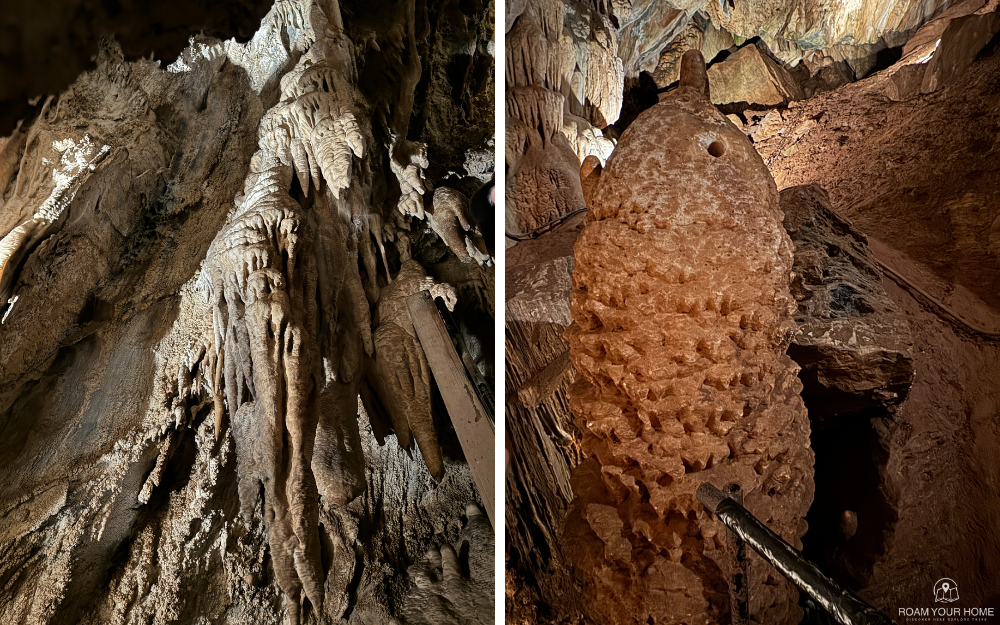
Our tour started promptly at the scheduled time. About five others joined my husband and me. We entered through a modern entrance. After a few steep steps down, which quickly became a theme of this tour, our guide said, “Everyone, go ahead and stop here, and welcome to Gothic Hall. This is the first and largest room on the tour.” It was stunning. You can see a fault line along the cave walls. The guide spoke about the history of Mercer Caverns and pointed out a few named formations, such as the sea turtle and the chocolate ice cream malt, a giant chocolate-colored stalagmite just off the tour path.
Moving down the trail, we came to a pillar on the walkway, which looked different from the rest of the cave walls. That is because it is the one part of the cave you are permitted — and even encouraged — to touch. Many caves will sacrifice a single formation to allow people to “get it out of their system” before venturing too far into the cave systems. That is because the oils on our hands prevent the cave from breathing and from growing. So once you touch it, there is no taking anything back. The damage is done.
From there, there were extremely steep back-to-back staircases that were very slippery. Taking it slow and steady like a mountain goat is a must through this stretch! Along the way, we passed the stunning “diamond cascade” waterfall formation and fantastic examples of cave bacon.
At the deepest point on the tour, we came to the pièce de résistance —a giant shining crystal wall made of aragonite crystals and moon milk. It is now safely behind plexiglass. However, Mercer chipped off a piece of moon milk and sent it to the World’s Fair in Paris in 1900. The piece of moon milk Mr. Mercer took is on display at the Natural History Museum in DC.
Next, we started making our way out of the caverns. I’d thought the first few staircases were steep, long, and slick. We were in for a surprise. On the way, you climb even steeper and longer staircases, which honestly made me a bit nervous.

Fat Man’s Misery
It was worth it, though. Along the way out, we passed through Fat Man’s Misery, which is a bit narrow, as you probably surmised. There are many incredible formations as well.
We got to experience total darkness, another fun thing to expect on almost every cave tour, no matter the location.
Mercer Caverns is the longest continually operating Show Cave in California. My husband and I are cave enthusiasts, and we thoroughly enjoyed our tour of Mercer Caverns. If you find yourself in Calvasas County, also check out Calvasas Big Trees State Park. Also nearby is Mark Twain’s Cabin.
Some things to keep in mind:
The tour is the equivalent of 16 stories, and what goes down steep stairs must go up steep stairs. It is rated as moderately strenuous, and I’d say that is accurate.
The inside temperature is a cool, moist 55 degrees year-round, so if you chill easily, bring sleeves.
Non-slip shoes are a must, as you will be on uneven surfaces that are wet from the limestone cave still forming.


