
The Native American Legend of Starved Rock
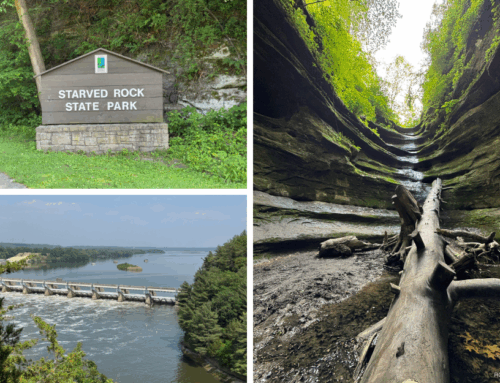
A highlight of any visit to Starved Rock State Park is the haunting Native American legend about how it got its name. The story has been passed down through generations in the Illinois River Valley.
According to the most popular legend, it’s a tale of assassination and revenge. On April 20, 1769, Ottawa War Chief Pontiac was killed in Cahokia by an Illinois Confederation warrior.
Seeking revenge, Ottawa Warriors and their allies, the Potawatomi, attacked a band of Illiniwek along the banks of the Illinois River. Forced to retreat, the Illiniwek climbed to the top of the steep sandstone butte to escape attacking Ottawa and Potawatomi warriors.
The natural fortress offered protection against direct assault, but it also proved deadly.
Unable to scale the rock, the attackers instead surrounded it, cutting off all access to food and water. Over time, the Illiniwek defenders, stranded high above the river with no supplies, perished from starvation. The tragic fate of those who sought safety atop the rock gave rise to its grim name, one meant to warn of both the brutality of conflict and the unforgiving nature of the landscape.
While modern historians question whether the event happened exactly as legend describes—or even at that specific location—regardless of its accuracy, the story became deeply ingrained in local oral tradition. Today, the legend of Starved Rock endures as a powerful reminder of Native American history, tribal rivalry, and the dramatic past hidden within one of Illinois’ most iconic natural landmarks.
In 1919, writer and poet Edgar Lee Masters penned a poem titled “Starved Rock,” a dramatic elegy mourning the Illini tribe, whose tragic deaths are remembered in the name of the striking butte overlooking the Illinois River.
Here is the poem.
Starved Rock, by Edgar Lee Masters
As a soul from whom companionships subside
The meaningless and onsweeping tide
Of the river hastening, as it would disown
Old ways and places, left this stone
Of sand above the valley, to look down
Miles of the valley, hamlet, village, town.
It is a head-gear of a chief whose head,
Down from the implacable brow,
Waiting is held below
The waters, feather decked
With blossoms blue and red,
With ferns and vines;
Hiding beneath the waters, head erect,
His savage eyes and treacherous designs.
It is a musing memory and memorial
Of geologic ages
Before the floods began to fall;
The cenotaph of sorrows, pilgrimages
Of Marquette and LaSalle.
The eagles and the Indians left it here
In solitude, blown clean
Of kindred things: as an oak whose leaves are sere
Fly over the valley when the winds are keen,
And nestle where the earth receives
Another generation of exhausted leaves.
Fatigued with age its sleepless eyes look over
Fenced fields of corn and wheat,
Barley and clover.
The lowered pulses of the river beat
Invisibly by shores that stray
In progress and retreat
Past Utica and Ottawa,
And past the meadow where the Illini
Shouted and danced under the autumn moon,
When toddlers and papooses gave a cry,
And dogs were barking for the boon
Of the hunter home again to clamorous tents
Smoking beneath the evening’s copper sky.
Later the remnant of the Illini
Climbed up this Rock, to die
Of hunger, thirst, or down its sheer ascents
Rushed on the spears of Pottawatomies,
And found the peace
Where thirst and hunger are unknown.
This is the tragic and the fateful stone
Le Rocher or Starved Rock,
A symbol and a paradigm,
A sphinx of elegy and battle hymn,
Whose lips unlock
Life’s secret, which is vanishment, defeat,
In epic dirges for the races
That pass and leave no traces
Before new generations driven in the blast
Of Time and Nature blowing round its head.
Renewing in the Present what the Past
Knew wholly, or in part, so to repeat
Warfare, extermination, old things dead
But brought to life again
In Life’s immortal pain.
What Destinies confer,
And laughing mock
LaSalle, his dreamings stir
To wander here, depart
The fortress of Creve Coeur,
Of broken heart,
For this fort of Starved Rock?
After the heart is broken then the cliff
Where vultures flock;
And where below its steeps the savage skiff
Cuts with a pitiless knife the rope let down
For water. From the earth this Indian town
Vanished and on this Rock the Illini
Thirsting, their buckets taken with the knife,
Lay down to die.
This is the land where every generation
Lets down its buckets for the water of Life.
We are the children and the epigone
Of the Illini, the vanished nation.
And this starved scarp of stone
Is now the emblem of our tribulation,
The inverted cup of our insatiable thirst,
The Illini by fate accursed,
This land lost to the Pottawatomies,
They lost the land to us,
Who baffled and idolatrous,
And thirsting, spurred by hope
Kneel upon aching knees,
And with our eager hands draw up the bucketless rope.
This is the tragic, the symbolic face,
Le Rocher or Starved Rock,
Round which the eternal turtles drink and swim
And serpents green and strange,
As race comes after race,
War after war.
This is the sphinx whose Memnon lips breathe dirges
To empire’s wayward star,
And over the race’s restless urges,
Whose lips unlock
Life’s secret which is vanishment and change.