
Exploring Mammoth Cave: Taking the Historic Tour at Mammoth Cave National Park
There are caves… and then there is Mammoth Cave — the longest cave in the world. The national park is located in the rolling hills of south-central Kentucky, north of Bowling Green, and is an easy drive from Nashville, Louisville, or Lexington.
We’ve visited Mammoth Cave many times and have done every tour the park offers, some of them a few times. The Historic Tour is the one we’ve done most and recommend to first-time visitors.
Taking the Historic Tour at Mammoth Cave National Park isn’t just a hike underground — it’s a walk through human history, geology, and imagination, all wrapped into two miles of dark and gloomy passageways.
A Brief History of Mammoth Cave
To truly appreciate the tour, it’s good to go in with some basic knowledge about the park. Long before it became a national park, Mammoth Cave was known to Native Americans, who explored its passages over 4,000 years ago. Archaeologists have found torches, footwear, and even naturally mummified remains deep inside the cave.
During the War of 1812, the cave transformed into an industrial site. Workers mined saltpeter — a key ingredient in gunpowder — hauling tons of material out of the passages. Some mining artifacts and vats remain today and are visible on the Historic Tour.
After the war, the cave slowly entered its tourism era. In fact, Mammoth Cave is the second-largest tourist site in the United States; only Niagara Falls in New York has attracted more visitors. As tourism blossomed, this is where its most important figure appeared: Stephen Bishop, an enslaved guide who became one of the greatest cave explorers in history. Bishop mapped large sections of the cave, discovered major passageways, and named many features that are still used today. His maps were astonishingly accurate, and his cave science advanced decades ahead of its time. Legend has it that Bishop’s ghost continues to explore the cave to this day.
By the late 19th century, Mammoth Cave was already world famous, drawing visitors from across America and Europe. Competing cave owners in the region created the famous “Kentucky Cave Wars,” aggressively advertising and even misdirecting tourists to lure them to their own caves.
In 1941, the federal government protected the area as Mammoth Cave National Park, preserving what we now know is the longest cave system on Earth — over 425 miles mapped and still growing.
Taking the Historic Tour of Mammoth Cave
After you pick up your tickets at the visitor center, you line up outside under a covered awning. The rangers give a brief safety and rules speech, then you are on your way. The adventure begins with a slow descent along a paved walkway to the natural entrance.
Insider tip: when touring caves, the front of the line always moves a bit slower… while the back moves a bit faster. If you’re like us and take way too many pictures and videos, I recommend being at the very front or at the very back. Both ends are flanked by a park ranger.
You will likely want a jacket even in the dog days of summer; the temperature in the cave remains consistent at 54°F year-round. The tour takes two hours and is two miles long, with 540 stairs, many of which you have to walk up!
Have your camera ready as you approach the historic entrance. The photo of the stairs leading into the entrance is a classic national park photo.
As you descend into the cave, the trail quickly shifts from daylight to soft lighting that mimics the experience early visitors had in the 1800s, which made the cave famous.
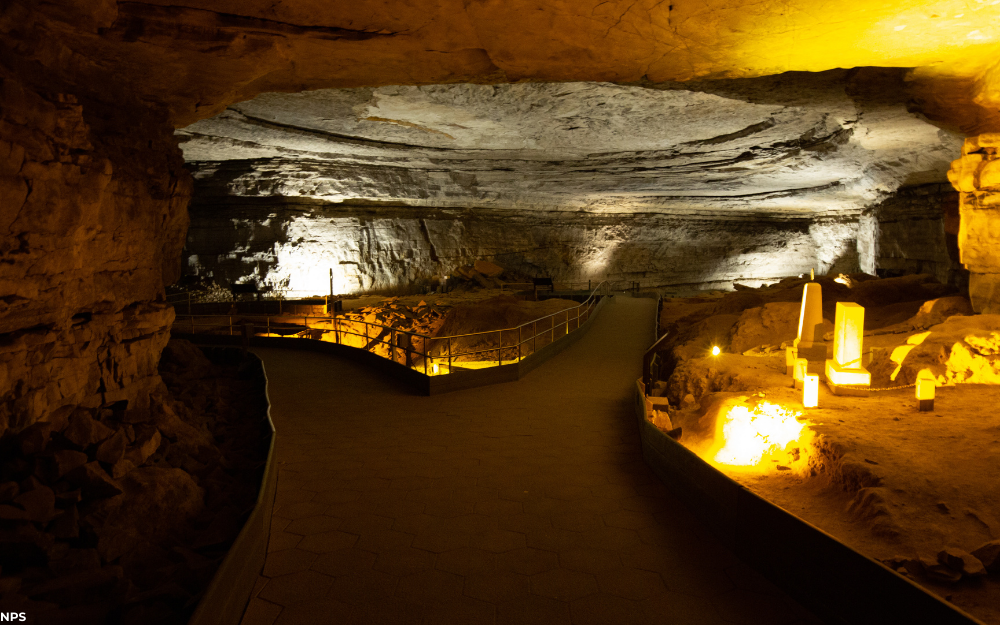
The Rotunda
The first major highlight of the tour is when you enter the rotunda. A visitor in 1810 wrote, “at the termination of these narrows you are ushered into one of the most sublimely beautiful and picturesque amphitheaters in the world.” This remains the case today. The cathedral-like chamber is big enough to hold buildings.
The rotunda is the most-visited room in the cave and is a quarter-acre in size, making it the sixth-largest room.
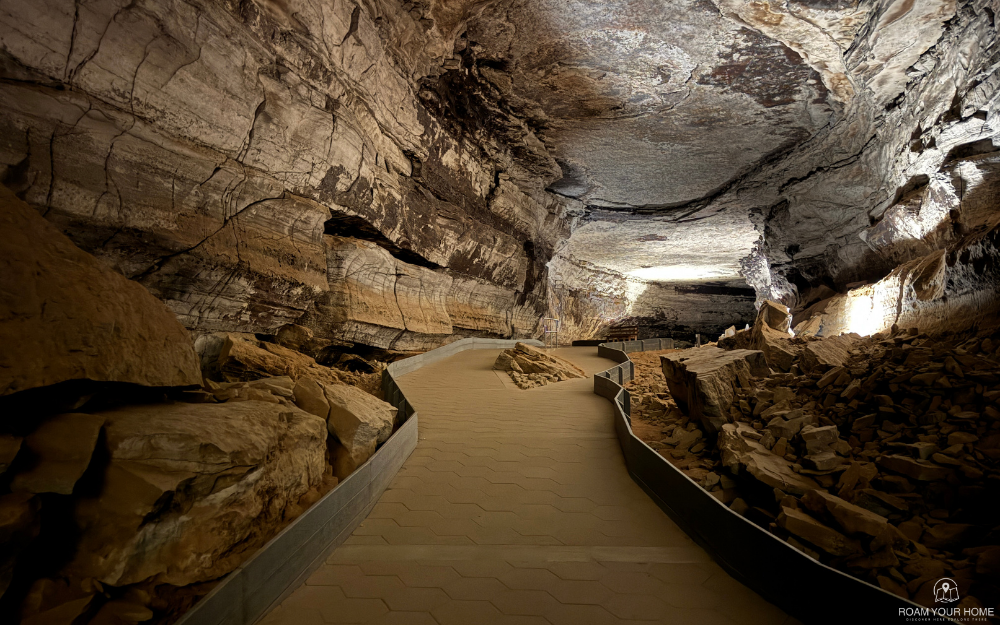
Broadway
Leaving the rotunda, you enter Broadway, which is a large passageway named by early visitors from New York. As you walk, look for an old dirt path next to the paved walkway. This is an old oxen wagon trail used for industrial purposes.
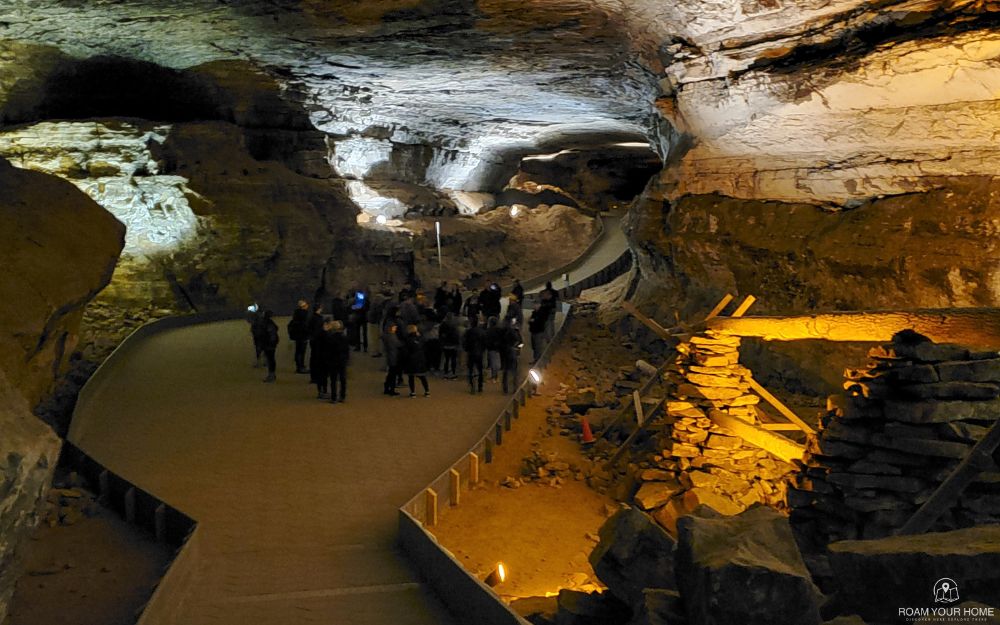
Methodist Church
Next, you enter the Methodist Church. This large room was used by a preacher in the 1830’s to hold services. You can still see blackened soot from lanterns on Pulpit Rock, where he gave the sermons. This is often a stop along the tour. Keep an eye peeled for a checkerboard pattern scratched into the limestone. This is a petroglyph from Native Americans. If the rangers don’t point it out, don’t be scared to ask.
Booth’s Amphitheatre
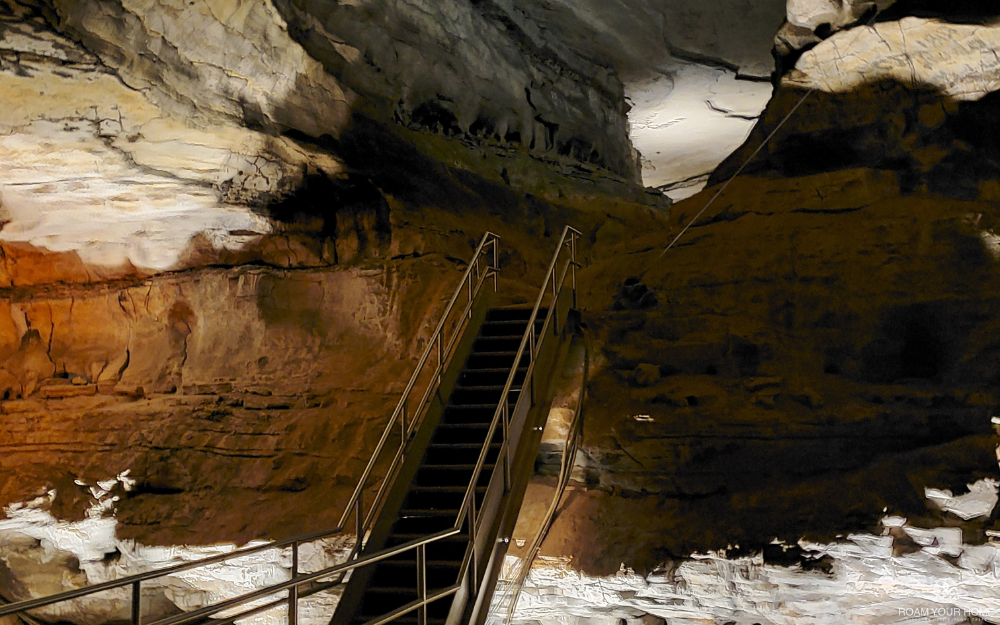
Booth’s Amphitheatre is the next area of the tour. The interaction is named after Edwin Booth, a famous actor in his time, and brother of John Wilkes Booth, the man who assassinated Abraham Lincoln. In 1876, Edwin Booth and his theatre troupe visited Mammoth. It was here he used a rock outcropping to give a recital of Hamlet’s soliloquy.
If you take the Gothic Avenue Tour (LINK) you would take a right here. The Historic Tour continues straight to the Giant’s Coffin.
Giant’s Coffin
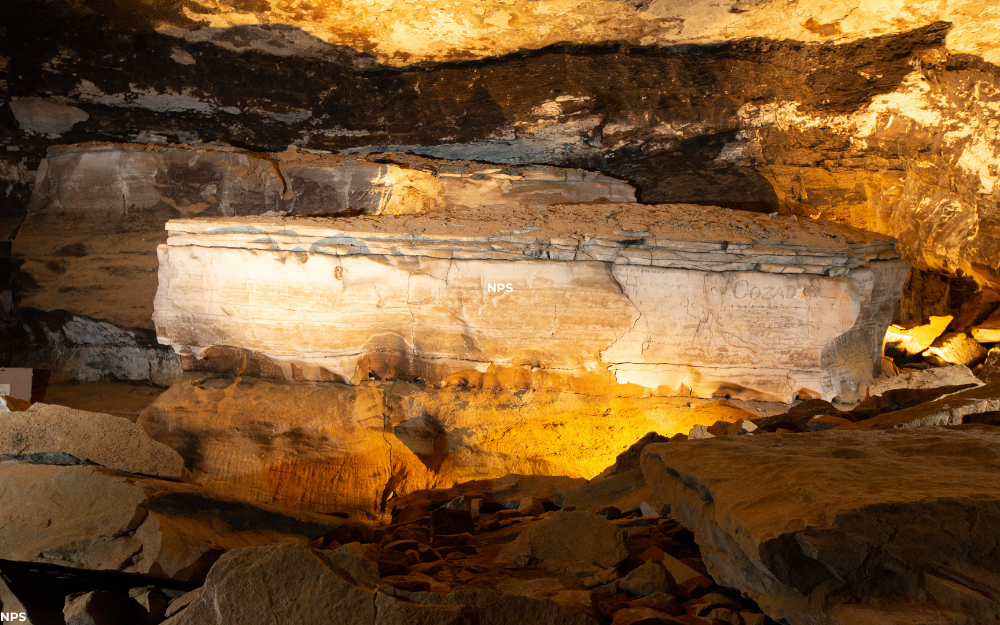
Soon you come to Giant’s Coffin. This has been a landmark on cave tours for more than 200 years. The massive boulder is more than forty feet long, twenty feet tall, and eight feet wide.
Look closely, you can see some historic signatures on it. On the left center side, look for “J N McDowell, MD 1839.” This signature was left by controversial doctor Joseph Nash McDowell. McDowell is remembered for illegally robbing graves to study human anatomy. He is believed to have served as the inspiration for the grave-robbing Dr. Robinson in Mark Twain’s The Adventures of Tom Sawyer.
Dante’s Gateway
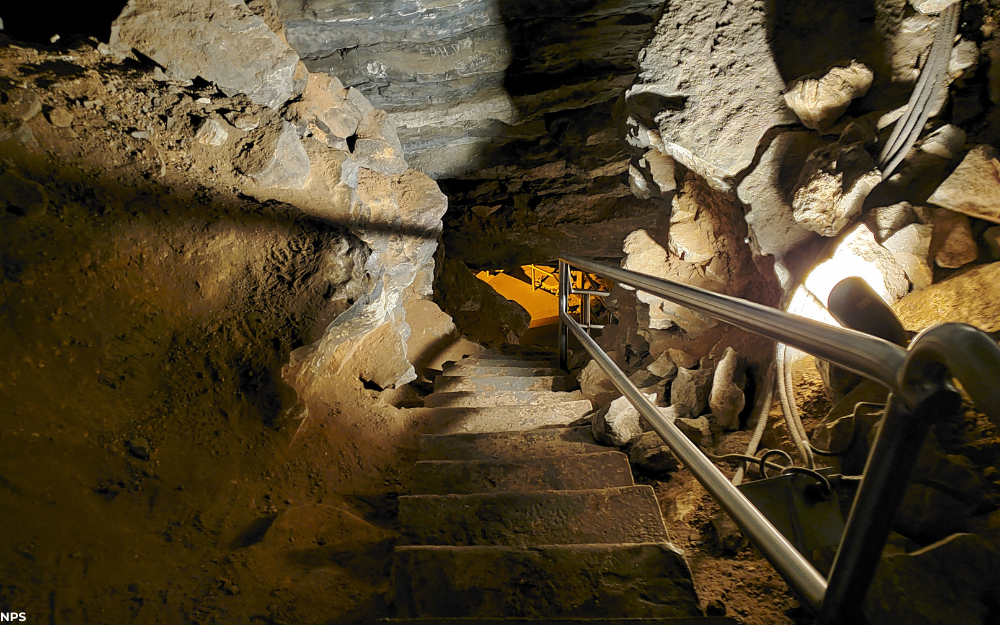
Dante’s Gateway is next on the tour. This tight passage down stone stairs is a great spot to whack your head if you are not careful. The narrow corridor is named after Dante Alighieri’s 14th-century poem, Inferno. In the poem, Dante’s Gateway is the entrance to hell. This is where the tour really begins to enter the small passages.
Wooden Bowl Room
Once you carefully make your way past Dante’s Gateway, you are not in hell, but rather the Wooden Bowl Room. This room is named after a piece of a Native American wooden bowl that early cave explorers found here.
You walk single file along Black Snake Avenue next. This is a great place to snap a few photos of historical graffiti, it is abundant along this stretch. Shortly after this, you go down some stairs and cross a metal bridge across Side Saddle Pit. Then you come to one of the highlights of the tour, the Bottomless Pit.
Bottomless Pit
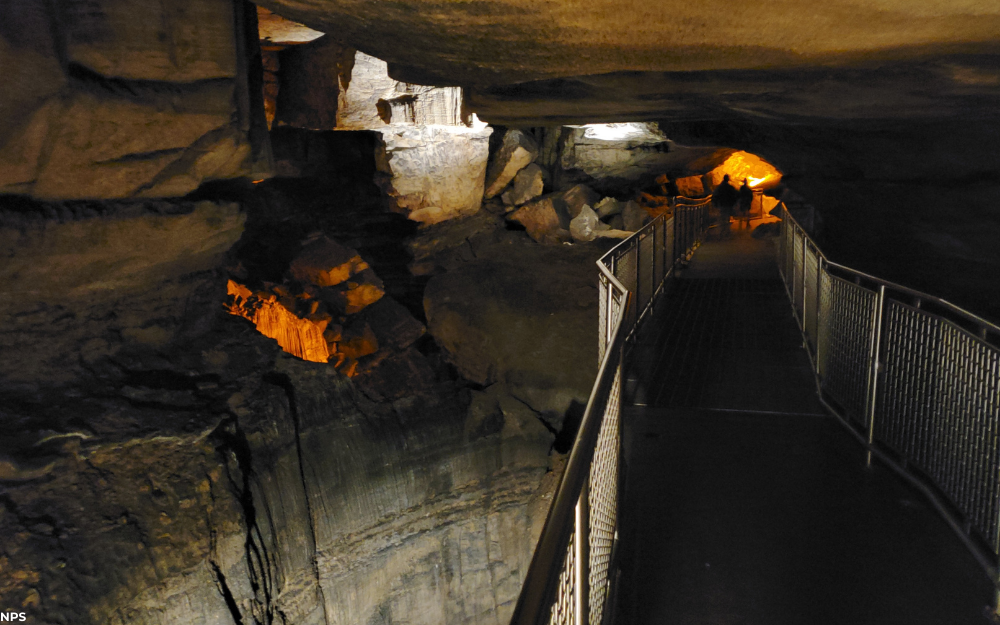
A steel bridge spans across the Bottomless Pit; historically, this was where tours generally stopped. By lantern light, the massive hole in the ground appeared to go on forever, hence its name. Today, we know it goes down 105 feet.
This is one of the more storied features along the Historic Tour. It was first crossed by legendary spelunker Stephen Bishop in 1838.
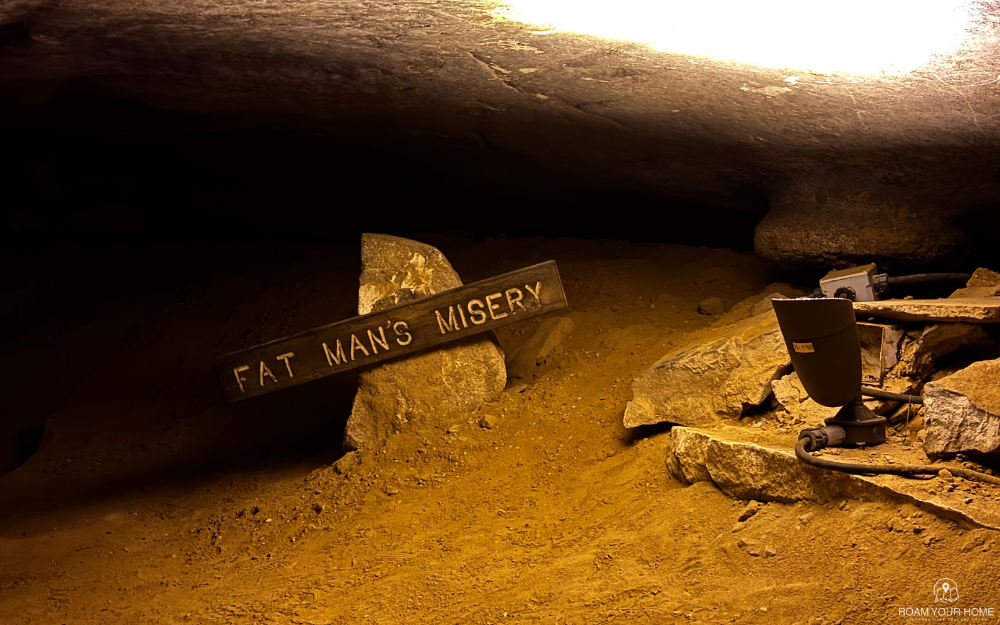
Fat Man’s Misery
Once you’ve crossed the Bottomless Pit, you work your way through a few low-hanging passages before entering Fat Man’s Misery. As you can imagine, this section is tight, narrow, and low. A visitor in 1866 described it as “… a tortuous rift, a snake in convolution and an avenue of torture in ruggedness, narrowness, and lowness. It would perplex a groundhog.” The entire passage is only 100 feet, but walking through, you are well aware of each one of them. At one point, the ceiling is only about 3 feet high. Fat Man’s Misery is a favorite of many folks because of its fun name and ruggedly accurate nature.
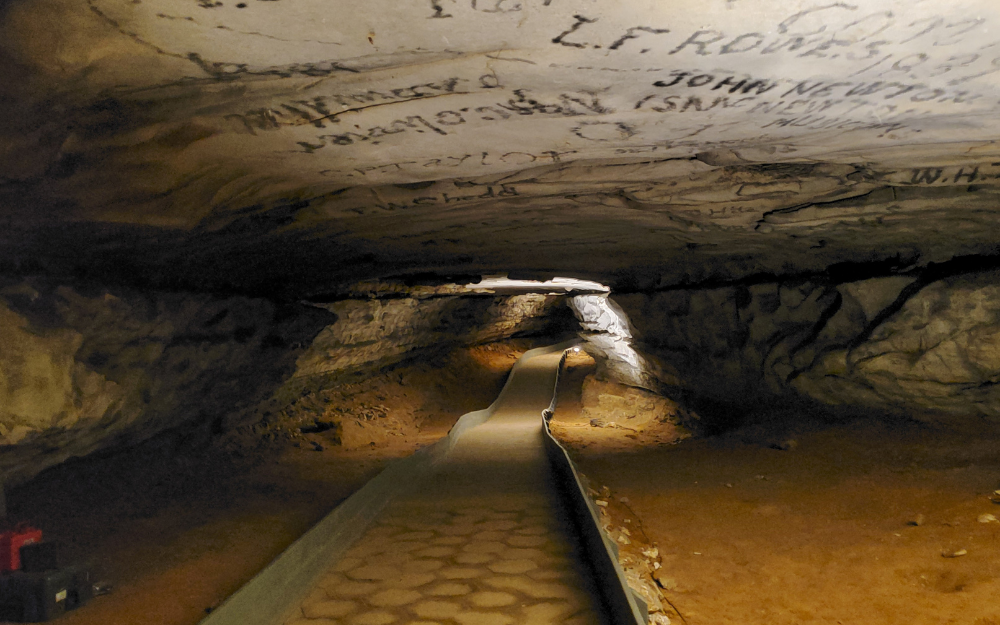
Great Relief Hall
The appropriately named Great Relief Hall is after Fat Man’s Misery. After navigating the narrow, low-hanging passage, it is certainly a relief to stand up straight. Make sure to look up as you walk through. There are signatures everywhere.
As you work your way through the Great Relief Hall, you come to a junction with two passages. The first is River Hall, which the Historic Tour follows. The other is Pensacola Avenue. While you don’t go down Pensacola Avenue, it’s worth a mention because Stephen Bishop left a lovely inscription to his wife there, “Charlotte Brown, the flower of Mammoth Cave.”
Moving forward through River Hall, you pass Bacon Chamber on the right as you begin to head down a narrow section known as Sparks Avenue. Then you come to another major highlight of the tour, the Mammoth Dome.
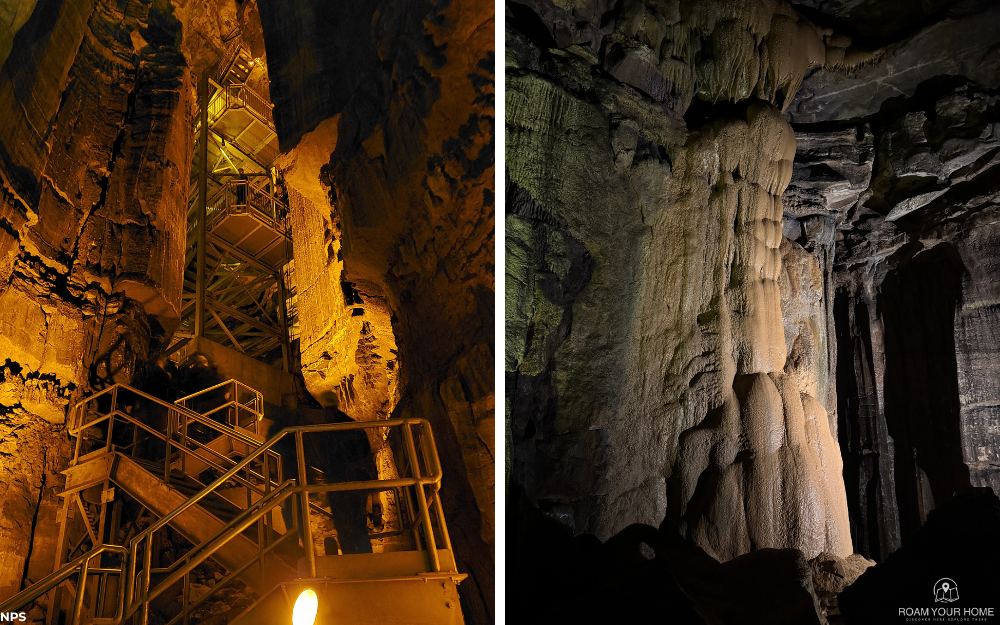
Mammoth Dome
This is the largest dome known in the cave. It soars more than 200 feet. This is also where the uphill begins. There are more than 140 stairs that switchback and forth. At least the views are amazing as you climb your way up. Once you get to the top, you make your way through Little Bat Avenue. While there are no longer bats there, historically, there were tens of thousands. You can still see evidence of them roosting on the ceiling.
Next, you continue up Audubon Avenue. In the mid-1800’s, Mammoth Cave’s owner, Dr. John Croghan, gave this section the name Audubon Avenue after his friend, the famed ornithologist and artist John Audubon. From there, you loop back through the Rotunda and back out the historic entrance, ending the incredible tour.
If you only have time to do one tour at Mammoth Cave, we recommend this one! That said, we also recommend staying a few days and doing multiple tours. Grand Avenue, the park’s longest tour, is another of our favorites.
Plan Your Visit to Mammoth Cave National Park
Address / Park Location
Mammoth Cave National Park is located in south-central Kentucky, near Cave City, Park City, and Brownsville. The main visitor hub is the Mammoth Cave Visitor Center, which is the starting point for cave tours and a good first stop for exhibits, maps, ranger information, and tickets.
Best Time to Visit
Mammoth Cave can be visited year-round, but spring and fall are especially good times to go because the weather is comfortable for hiking above ground. Summer is the busiest season, so book cave tours in advance and expect larger crowds. Winter can be quieter, though tour schedules and services may be more limited.
Parking
Parking is available at the Mammoth Cave Visitor Center. Since the visitor center is the departure point for cave tours, plan to arrive early enough to park, check in, use the restroom, and get to your tour meeting area before your scheduled time.
Cost / Pass Needed
There is no entrance fee to Mammoth Cave National Park. You can visit the surface areas, trails, visitor center, and overlooks without paying an entrance fee. However, cave tours, camping, and some reservations do have fees. America the Beautiful passes do not cover the cave tours.
Time Needed
Plan on spending at least half a day at Mammoth Cave National Park. A shorter visit can include the visitor center and one cave tour, while a fuller visit could include hiking, overlooks, historic sites, ranger programs, the Green River area, or a second tour. If this is your first visit, give yourself extra time so the day does not feel rushed.
Trail Length
Trail length depends on what you choose to do. Cave tours vary by route, difficulty, stairs, and distance, so check the specific tour description before booking. Above ground, the park also has hiking trails through forests, river overlooks, sinkholes, cemeteries, and historic landscapes. Choose a cave tour and surface trail that fit your time and comfort level.
Accessibility
Accessibility varies widely at Mammoth Cave. The visitor center and some surface areas are more accessible, but many cave tours include stairs, slopes, narrow passages, low ceilings, or uneven surfaces. There is an Accessible Tour; however, anyone with mobility needs should check current conditions or call the visitor center before booking.
Nearby Stops
Nearby places to pair with Mammoth Cave include Cave City, Dinosaur World, Diamond Caverns, Lost River Cave in Bowling Green, Barren River Lake State Resort Park, and Abraham Lincoln Birthplace National Historical Park. If you are building a larger Kentucky road trip, Mammoth Cave also pairs well with Lincoln sites, bourbon country, and other cave country stops.
Official Website
Before visiting, check the official National Park Service website for Mammoth Cave National Park for current cave tour schedules, ticket availability, visitor center hours, road and ferry status, trail conditions, closures, and safety alerts.
FAQ
Is Mammoth Cave National Park worth visiting?
Yes. Mammoth Cave is home to the world’s longest known cave system and is one of Kentucky’s most unique national parks. It offers cave tours, hiking, river scenery, historic stories, and a landscape shaped by underground geology.
Do you need reservations for Mammoth Cave tours?
Reservations are strongly recommended. Cave tours can sell out, especially during summer, weekends, holidays, and school breaks. Booking ahead is the best way to get the tour and time you want.
Is Mammoth Cave National Park free?
Yes, entry to the park itself is free. However, cave tours, camping, and some reservations require separate fees.
How long should you spend at Mammoth Cave National Park?
Most visitors should plan for at least half a day. If you want to take a cave tour, explore the visitor center, hike a surface trail, and see more of the park, plan for most of the day.
Can you visit Mammoth Cave without a tour?
You can visit the park, visitor center, trails, and surface areas without taking a cave tour. To go into most cave areas, you generally need a ticketed tour or authorized program.
Which Mammoth Cave tour is best for first-time visitors?
For first-time visitors, choose a tour based on your comfort with stairs, distance, tight spaces, and time. The Historic Tour is a classic option when available, while shorter tours may be better for families or visitors seeking a more accessible introduction.
Is Mammoth Cave good for kids?
Yes. Mammoth Cave can be a great family stop, especially if you choose a tour that matches your child’s age, attention span, and comfort level. Shorter tours are often better for younger kids, while older kids may enjoy longer or more adventurous options.
What should you wear to Mammoth Cave?
Wear comfortable walking shoes with good traction and bring a light jacket or layer. The cave is much cooler than summer temperatures outside, and cave paths may include stairs, slopes, or damp surfaces.