

Facing Ginevra: A Renaissance Whisper at the National Gallery
Walking into the National Gallery of Art in Washington, D.C., can be an overwhelming experience. There are so many things to see and so many things you don’t even realize you want to see!
On our first visit to the museum, we knew very little about what to expect, but we did know one piece of art we did not want to miss: Ginevra de’ Benci, painted by Leonardo da Vinci.
The painting’s namesake, Ginevra de Benci, was a well-known young Florentine woman. It was painted in Florence between 1474 and 1478 and is considered one of only three of his surviving portraits of women. Ginevra is thought to have been about 16 years old at the time of the painting. Some 30 years later, he would paint his most well-known work, the Mona Lisa.
It’s a rare masterpiece in the Western Hemisphere. The tiny 38 × 37 cm portrait is the sole Leonardo painting you can see publicly in the Americas. It’s one of only a little more than 20 known works of Leonardo—buy the only one you can see without a trip to Europe.
Ginevra de’ Benci is in Gallery 6, protected in a glass-enclosed panel perched on a marble plinth. I recommend sitting and taking a moment to reflect while enjoying the painting. Ginevra’s pale face, near-silent expression, and penetrating gaze meet yours.
It’s human emotion in a small frame. Unlike the Mona Lisa’s enigmatic presence, Ginevra’s austere beauty and direct gaze draw you in quietly.
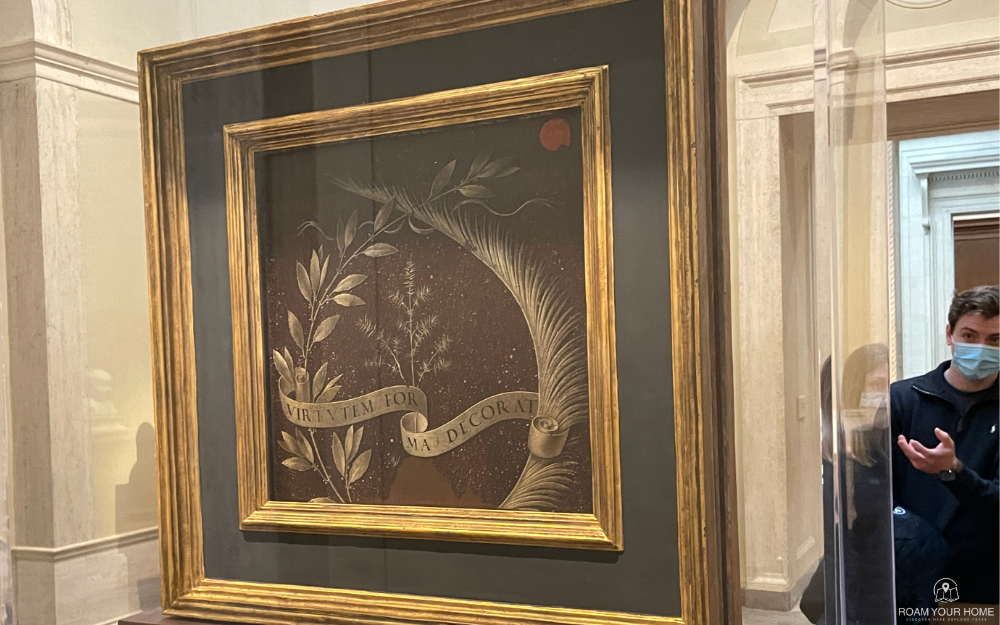
The Journey to Washington
It was housed in a Liechtenstein castle for 250 years before the National Gallery of Art acquired it in 1967 for a record-breaking $5–6 million. Getting the priceless work of art cool castle basement to the United States would prove tricky.
The artwork was placed in a custom temperature and humidity-controlled suitcase. The modest luggage allowed the museum to transport and protect the work without drawing any attention to the precious cargo. A first-class seat for the painting under the name “Mrs. Modestini.” Mr. Modestini was then the National Gallery’s painting conservator.
When the painting arrived in Washington, D.C., it made national news. When Ginevra de’ Benci later went into public view, it was immediately met with long lines of visitors. Nearly 1,000 people saw the painting in the first hour it was on view.
Next time you’re in D.C., take some time to visit the National Gallery of Art and let a teenage Florentine aristocrat’s eyes tell their story.